
Checklist
Recruiting Outreach Checklist
A structured outreach workflow helps recruiting teams stay consistent, reduce missed follow-ups, and keep candidates moving through the pipeline.
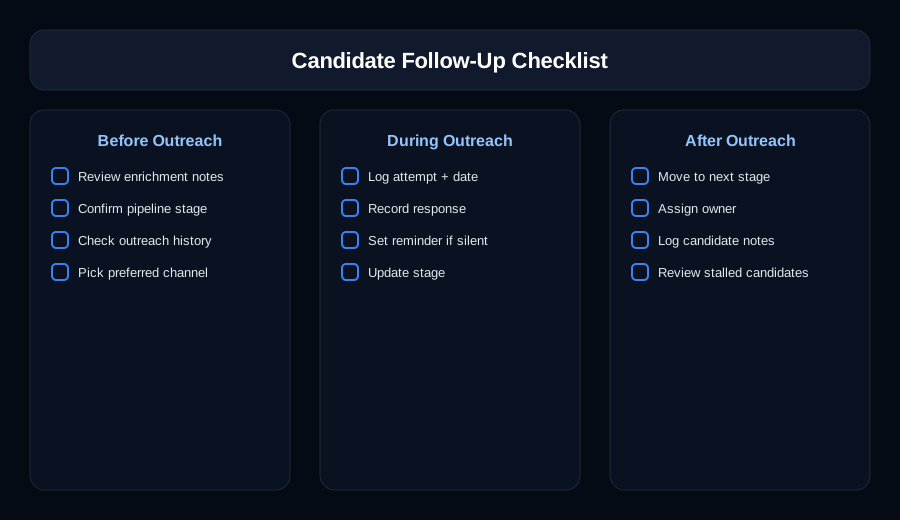
Before outreach
- Review candidate enrichment data and role-fit notes
- Confirm pipeline stage and next action are up to date
- Check previous outreach history and engagement status
- Select the outreach channel based on candidate preference
During outreach
- Log the outreach attempt with date, channel, and summary
- Record candidate response or non-response
- Set a follow-up reminder if there is no response within your expected window
- Update candidate stage based on the response outcome
After outreach
- Update pipeline stage to reflect the next step (screening, interview, nurture)
- Assign an owner for the next action if handing off to a teammate
- Log recruiting notes about candidate interest, availability, and preferences
- Review pipeline health metrics to catch stalled candidates early
Common mistakes
- Sending outreach to a candidate without checking prior contact history first.
- Skipping the follow-up reminder step, so a non-response silently ends the conversation.
- Treating a high response rate as a guarantee of future placements or revenue.
Frequently asked questions
Does TalentSyncHQ send mass outreach messages automatically?
No. TalentSyncHQ helps you log, organize, and follow up on outreach your team sends. It does not encourage mass messaging or spam.
How often should follow-up reminders repeat?
Most teams use a 3-5 business day window for a first follow-up, then space subsequent attempts further apart based on candidate responsiveness.
Direct answer
Candidate sourcing is the process of identifying relevant people, recording source context, contacting them responsibly, tracking responses, and moving qualified candidates into a recruiting pipeline.
Use this page when the goal is operational: improve candidate outreach and follow-up. The content should stay focused on recruiter and hiring-team decisions, not job-seeker coaching or unsupported predictions.
Sourcing workflow framework
A strong recruiting workflow is built from visible decisions. The team should be able to see the candidate record, the reason a person is in scope, the current stage, the next owner, and the evidence used for each hiring or recruiting decision.
- Define the role, must-have requirements, and search boundaries.
- Identify permitted sourcing channels and record source context.
- Create candidate records before outreach starts.
- Send role-relevant outreach and log every response.
- Move qualified candidates into pipeline stages with next actions.
| Workflow element | What to verify | Why it matters |
|---|---|---|
| Step 1 | Outreach is tied to a real role or future-fit segment. | Keeps the workflow auditable, current, and useful for handoffs. |
| Step 2 | Message context is relevant to the candidate's background. | Keeps the workflow auditable, current, and useful for handoffs. |
| Step 3 | Every outreach has a follow-up task or closure rule. | Keeps the workflow auditable, current, and useful for handoffs. |
| Step 4 | Responses are logged on the candidate record. | Keeps the workflow auditable, current, and useful for handoffs. |
| Step 5 | Do-not-contact or opt-out signals are respected. | Keeps the workflow auditable, current, and useful for handoffs. |
Candidate outreach checklist
Run this checklist during weekly pipeline review, campaign review, or interview debrief. If a record fails the checklist, either update it, assign a next action, or move it out of the active workflow.
- Outreach is tied to a real role or future-fit segment.
- Message context is relevant to the candidate's background.
- Every outreach has a follow-up task or closure rule.
- Responses are logged on the candidate record.
- Do-not-contact or opt-out signals are respected.
Implementation examples
Agency search
Create a campaign for one client role, add sourced candidates, log first outreach, and review follow-ups every morning until the search has enough qualified conversations.
Small business hiring
Start with referrals and known networks, keep a short nurture list, and only expand sourcing channels when the pipeline lacks qualified candidates.
Common mistakes to avoid
- Sourcing names without attaching them to a role, campaign, or follow-up plan.
- Using unauthorized or unreliable candidate data.
- Sending generic outreach that does not explain role relevance.
- Letting follow-ups depend on memory or inbox flags.
Limits and responsible use
TalentSyncHQ should support recruiter judgment, documentation, and collaboration. It should not be presented as a guarantee of hires, interviews, placements, response rates, or revenue.
- Do not scrape or use candidate data in ways that violate platform rules or applicable law.
- High outreach volume does not guarantee candidate interest or responses.
- Candidate engagement depends on role fit, timing, message quality, and market conditions.
Operational playbook
Treat recruiting outreach checklist as an operating habit, not a one-time setup task. The first pass should define fields, owners, and review cadence. The second pass should test whether a teammate can understand the record without asking the original recruiter for context. The third pass should remove stale work so the active view only shows candidates, campaigns, or decisions that still need action.
The best resource pages answer the immediate question and then show how to use the answer inside a recruiting workflow. That means every recommendation should tie back to a visible candidate record, a pipeline stage, a task, a note, a metric, or a human-reviewed decision. Avoid abstract advice that cannot be checked during a pipeline review or interview debrief.
When this workflow is implemented in TalentSyncHQ, the team should be able to open a candidate or campaign and see what happened, why it happened, who owns the next action, and what evidence is still missing. That trace is what makes the workflow useful for recruiters, founders, agencies, and hiring managers working from the same system.
| Decision point | What to capture | Review trigger |
|---|---|---|
| Entry | Source, role fit, campaign, owner, and reason the record exists. | Before outreach or before adding the record to an active stage. |
| Movement | Evidence, response, interview note, or client feedback that changed the status. | Whenever a candidate moves, stalls, rejects, or enters nurture. |
| Follow-up | Next action, due date, owner, and message context. | Daily for active searches and weekly for nurture segments. |
| Decision | Job-related evidence, missing information, concern, and human reviewer. | Before shortlist, rejection, client submission, offer, or archive. |
Step-by-step implementation
- Choose the primary workflow owner and document which team members can update records.
- Define the fields that must exist before a candidate, client search, or campaign becomes active.
- Map each field to a decision it supports so the team does not collect data for its own sake.
- Set a review cadence for active work, stale records, overdue tasks, and missing evidence.
- Create a handoff rule for any candidate who moves between recruiters, interviewers, or client owners.
- Review the workflow against fair-hiring expectations and remove protected-trait assumptions.
- Keep a short change log when stage names, scorecard criteria, or reporting definitions change.
This process gives the team a repeatable way to improve content quality, candidate experience, and recruiting visibility without inventing new claims. If a metric, note, or recommendation cannot be supported by the visible record, it should be rewritten as a question or follow-up.
Quality review before publishing
Before this guidance is treated as production-ready, review the page for search intent, internal links, metadata, schema, and accessibility. The page should answer one core intent, support related questions naturally, and avoid creating another page that competes for the same primary keyword.
- The primary keyword is unique and does not overlap with an existing stronger page.
- The H2 and H3 structure supports scanning on mobile and desktop.
- FAQs are visible on the page before they are marked up with FAQPage schema.
- HowTo schema is used only when the visible section contains actual steps.
- External references support process, compliance, or hiring context without fabricating data.
- Every CTA points to the next useful action: product, pricing, signup, or a related guide.
Editorial coverage requirements
The finished page should explain what the workflow is, when to use it, who owns it, which records it affects, and how the team knows whether it is working. A reader should leave with a practical model they can apply inside a recruiting CRM, candidate pipeline, sourcing campaign, outreach sequence, metrics review, or interview workflow.
Keep the page anchored to recruiting outreach checklist, then support that keyword with related language such as candidate sourcing, sourcing process, candidate outreach, candidate engagement. These terms should appear only where they help explain the process. Do not force them into headings, image alt text, FAQs, or CTAs if they make the page sound unnatural.
The strongest version of this page includes examples for both small teams and agencies, because those readers often share the same workflow problem but need different levels of structure. A small team usually needs clarity, ownership, and fewer missed follow-ups. An agency usually needs campaign separation, client-specific notes, candidate reuse, and accurate status reporting across multiple searches.
If a section feels thin, expand it with an example, a decision rule, a checklist item, or a caution about responsible use. Do not add invented statistics, fake benchmarks, fake testimonials, or unsupported claims. If the page needs proof, use an authority reference for process context or a product screenshot/image brief that illustrates the workflow.
- Include a direct answer near the top for searchers who need the short version.
- Answer related People Also Ask-style questions in the body before the FAQ.
- Show how the workflow changes by team type, role type, or recruiting model.
- Explain what can go wrong when records, ownership, or evidence are missing.
- End with a conversion path that fits the reader's stage: related guide, pricing, or signup.
Frequently asked questions
What is the sourcing process in recruitment?
It is identifying potential candidates, checking role relevance, recording source context, contacting them, tracking responses, and moving qualified people into the pipeline.
How can recruiters keep candidates engaged?
Keep outreach specific, set timely follow-ups, share clear next steps, and avoid going silent after screening or interviews.
How do you build a pipeline of candidates?
Start with role criteria, source relevant people, create records, log outreach, screen interested candidates, and maintain nurture segments.
What are the three Ps of recruitment?
A practical operations model is people, process, and pipeline: know who you need, define how you evaluate, and track how candidates move.
What are the five elements of talent acquisition?
Role definition, sourcing, candidate engagement, evaluation, and hiring process coordination.
How does TalentSyncHQ help?
TalentSyncHQ keeps sourced candidates, campaigns, outreach status, notes, and follow-up tasks together.
Recommended internal links
Authority references
Suggested image briefs
candidate-sourcing-to-pipeline-workflow.webp
Create a five-step workflow diagram from role criteria to sourced candidate record, outreach, screening, and pipeline stage.
- Purpose
- Map sourcing to pipeline
- Placement
- After direct answer
- Alt text
- Candidate sourcing workflow from discovery to pipeline stage
Use TalentSyncHQ to connect sourcing campaigns, candidate records, outreach status, and follow-up tasks.
Create free account